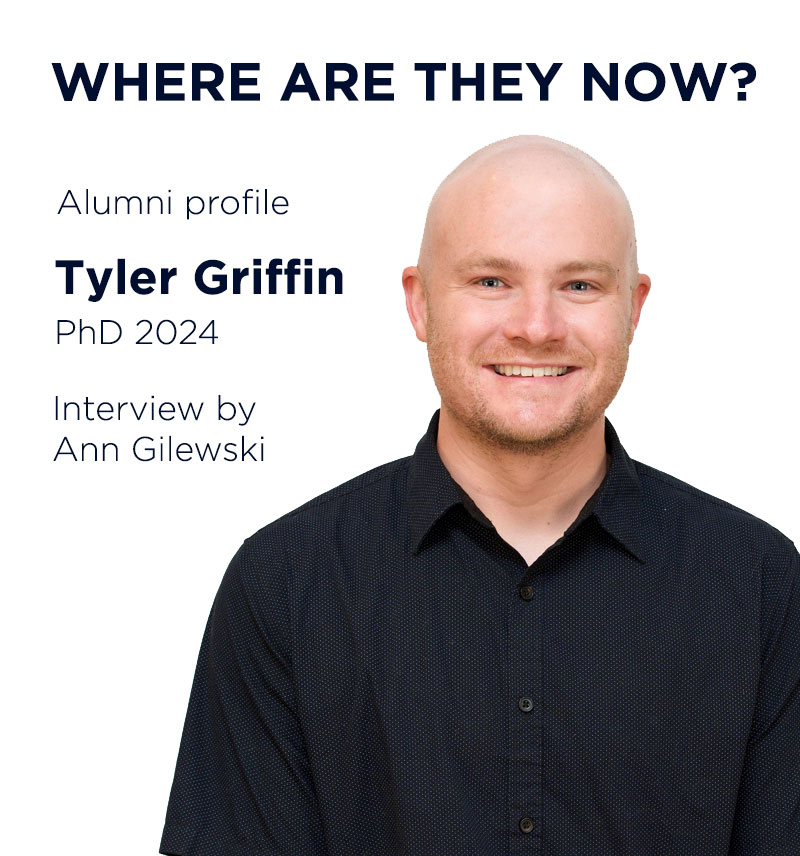
Anne: Why did the topic of microbial biology of mussels interest you?
Tyler: My dissertation investigated the bacterial communities associated with blue mussels and ribbed mussels (i.e., their microbiomes). Among the various chapters, I was elucidating the microbial community structure of their guts and feces under natural conditions and in response to anthropogenic disturbances. One of my core findings was that the mussel’s gut microbiome should really be considered as two separate groups of microbes: the resident group that lives full-time in the digestive tract (and may interact more intimately with the animal) and the transient community, which is more diverse and consists of ingested microbes that either get digested in the gut or pass right through with feces.
Going into graduate school I knew I was passionate about marine invertebrates and fascinated by microbial symbioses. Mussels make an excellent study species for this type of research because they are easy to collect in Long Island Sound, hardy and amenable to durations in the laboratory for experiments, and important members of coastal ecosystems. Bivalve molluscs are so interesting because their anatomy differs greatly from the typical vertebrate anatomy (e.g., different than us humans). Much is being learned about the human microbiome and its role in health and disease, but all animals with a gut might also interact significantly with digestive microbiota. Perhaps the anatomical, ecological, and evolutionary differences between vertebrates and invertebrates like mussels have led to significant differences in relationships with microbiota. These possibilities keep me committed to this research. To have a fuller understanding of animal biology and the marine environment as a whole, we need to better refine our understanding of invertebrate animals as ecosystems for microorganisms and better evaluate the relationships that take place between microscopic and macroscopic organisms. Long story short: mussels are cool little aliens and I wanted to investigate an aspect of their biology that was previously understudied (and that modern technologies allow us to examine in fine detail).
Anne: What inspired you to complete a doctoral degree?
Tyler: I had the opportunity to engage in collaborative research with faculty members when I was doing my undergraduate studies. I loved the research experience, mostly the excitement about discovering something about the natural world that no one had ever known. I was hungry to make a career out of research, so graduate school was the logical next step. During my first year in the Oceanography PhD program at UConn, I was a TA for Introduction to Oceanography lab. The experience was challenging but incredibly rewarding, and it opened my eyes to the possibility of combining teaching and research into a career as a college professor. My mom has a doctoral degree in education and worked for many years as a college professor, and it suddenly made sense what my path should be. So, it all kind of clicked into place for me and the goal became to complete the PhD and seek out a job as a faculty member at a primarily undergraduate institution.
Anne: What challenges did you have along the way?
Tyler: COVID definitely posed some significant challenges. I had to postpone experiments and pivot on some projects during those months where we couldn’t go into the Lowell Weicker Building. COVID hit at a point in my graduate career when I still needed to take my general exam part B (PhD students in the Ward lab take a written part B exam). So I decided to make the most of the time I couldn’t make progress on research and study hard for the part B. It wasn’t exactly a fun experience, but at least I was productive and became well-prepared for the exam.
In the early months of my graduate career, when I was still formulating what my specific dissertation would be, there were several moments when I felt overwhelmed, lost, and out of my league. In retrospect, this is understandable and natural for a first-year graduate student straight out of an undergraduate program. What got me out of that rut and back on the path toward confident progress was the community of fellow graduate students in the department and my advisor, Dr. Ward. The Marine Sciences Dept. is full of outstanding people, leaning on their kindness and wisdom is a huge advantage.
Anne: What has life been like post-graduation?
Tyler: Life post-graduation has been a whirlwind! Immediately after my dissertation defense I started a postdoc job at Bowdoin College in Maine where my role was primarily teaching undergraduate biology courses. Then after the academic year I took the summer off to get married (yay!), went on my honeymoon, and moved back to CT. This Fall I started my new job as a tenure-track assistant professor of Biology at Fairfield University. I can confidently say my teaching experiences in the Marine Sciences Dept. during my graduate career were a huge factor in me getting both my postdoc fellowship and current professorship. During the application/interview processes, the potential employers saw that my robust TA experience coupled with my role as an instructor of record meant that I was serious about honing my skills as an educator.
Anne: I am an undergrad in Marine Sciences. What advice might you have for a student considering a graduate degree?
Tyler: The truth is that graduate school isn’t for everyone. I think the best way to approach the decision whether to go to graduate school is best framed through a career-lens. Does the job/career you truly want require a graduate degree? If yes, then that’s a reason to do graduate school. If the answer is no or “I don’t know”, then I might recommend cautious reevaluation. That’s especially true for a PhD program where you might spend 5+ years of your life. You don’t have to start graduate school right away, sometimes six months, a year, or two years of real-world experience can clarify the career question posed above.
Graduate school is partly like an undergraduate program in that there is a considerable amount of coursework. But there is also a research component. There may also be TA responsibilities. In general, your life and path to graduation is much less prescribed for you as a graduate student. It helps to be self-motivating, organized, and punctual in addition to being curious and a diligent worker. Another under-looked part of being a graduate student is the human element. Is the potential graduate program in a physical location where you’d enjoy living? Would you have a support network available to you? Does the school offer graduate students health insurance? Are the stipends enough to live on? These are all questions just as important as ones about curricula or research/advisor fit. Burnout is real and graduate students need to be experienced in self-care. It’s a lot to juggle!
Anne: What was a particularly memorable moment of your graduate program?
Tyler: There are too many memorable moments to name! I was in the graduate program for a long time (seven years!), and there were so many seminal experiences that influenced my development personally and professionally. Celebrating with my peers and lab members after passing the general exam… Spilling seawater that I was trying to pour from a graduated cylinder all over the lab bench because I had been working for 34 straight days, and laughing uncontrollably because laughing was better than crying… Early morning and late night fieldwork in beautiful locations… Leaving at 4 pm for impromptu happy hours with my office mates… Getting notified that my first manuscript had been accepted for publication… Overcoming my nerves about public speaking to stand in front of an audience to teach or present research for the first time… Watching my first undergraduate mentee overcome her nerves and give an incredible research presentation…. Shaking hands with Dr. Ward and my committee members as they told me I passed my dissertation defense… Truly becoming an expert in something, learning how to learn, and forging relationships and friendships that will last a lifetime.